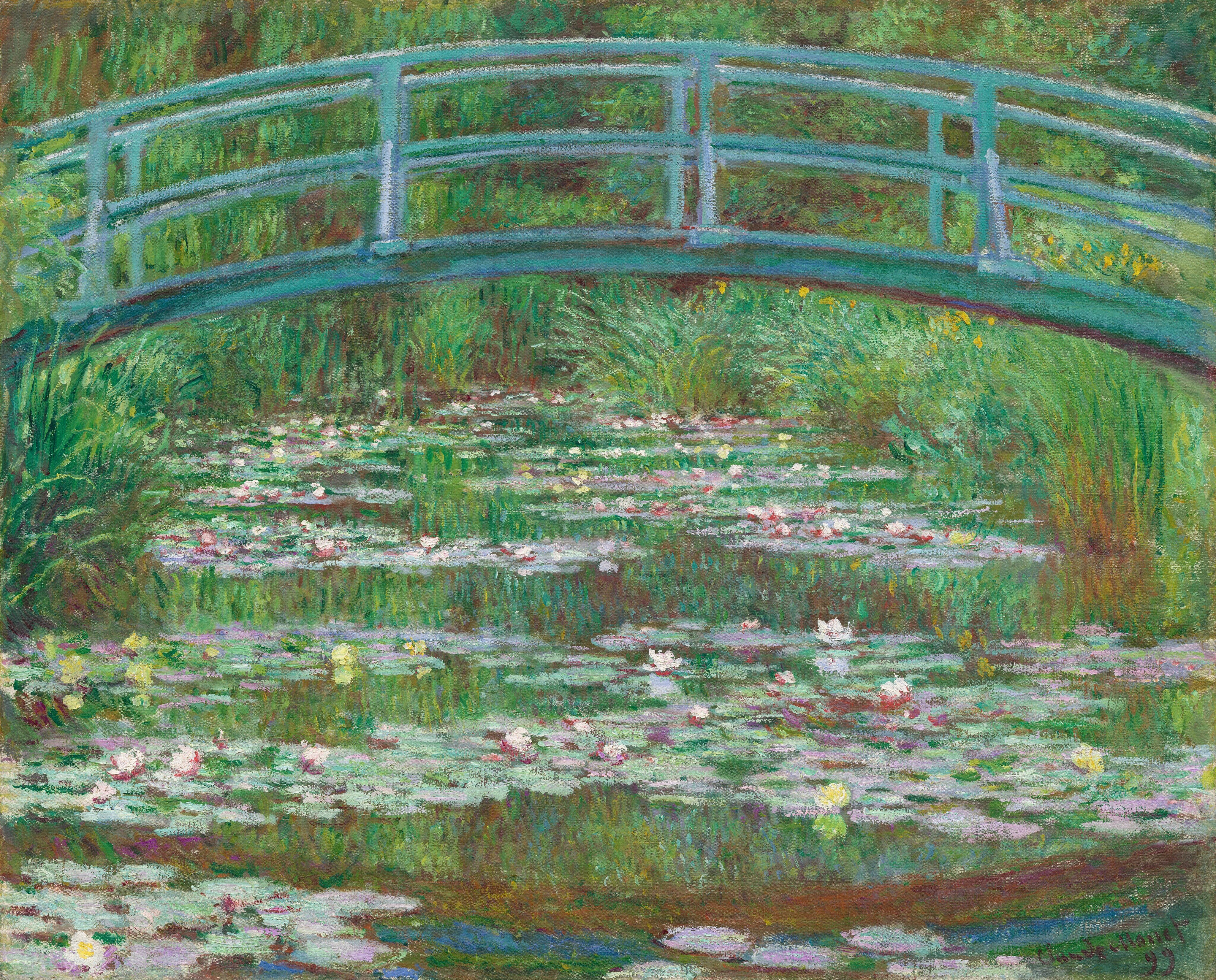
The Japanese Footbridge
Claude Monet · 1899
In 1883 Monet moved his household, his two sons along with Alice Hoschedé and her children, to the rural community of Giverny, where he leased a house that he was able to purchase seven years later. In early 1893, he acquired a swampy area across the railroad tracks abutting his property and petitioned the village council for permission to divert a small stream into it. But it was only toward the end of that decade that he turned to the garden he had created there as a rich source of artistic inspiration.
In 1899, Monet painted 12 works from a single vantage point, focusing on the arching blue–green bridge and the microcosm of his water garden. Among the 12 works was the National Gallery's Japanese Footbridge. Monet designed and built the landscape that appears in the painting—from the bridge to the pond and its shape, to the water lilies and other plantings. The artist, who as a leader of the impressionists had espoused the spontaneity of directly observed works that capture the flee
Available
$1,680
Shipped flat in a crate, tracked and insured.
Prices converted at today’s rate.
Customs and import duties are the buyer’s.
Demo checkout: no money is taken. Pay with the test card 4242 4242 4242 4242, any future expiry date, any CVC.
Share
- Medium
- Painting
- Dimensions
- 39.8 × 31.9 in
- Year
- 1899
- Series
- Landscape
- Categories
- Landscape
- Styles
- Impressionism
- Materials
- Oil